 |
|
 |
|
The English pages are not updated. Please do not use the English lore texts for RPing in Néveri. We will begin to work on the English site again if interest in it returns.
V chapter of Néveri’s creatures
Male
Female
Preface Written on the 26th day in the sign of Aerth in the year 3451
In the beginning.. While Filarka was trapped in time, the rest of the malenkais began to spread out into the blessed area named Karstaag by the legendary Aremir. For a long time we lived hidden from all other creatures, but the day came when a malenkai spoke against king Kaaras and turned his back on Avia and her blessing. Those malenkais are known today as the midnight clan and they live in the southern parts of Karstaag. These malenkais fell prey to Nisara’s curse again, soon after their betrayal against king Kaaras, and you humans fear these malenkais the most -- Except those of you so unfortunate to live close to the red circle located in the western woods.
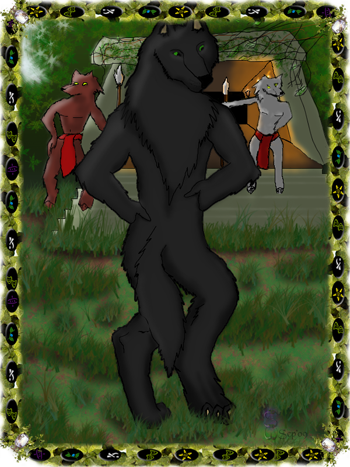
Malenkais are not werewolves We do not need a magical belt, a ritual, or the aid of a magician to change our form, as has been claimed over the years. The full moon has no effect on us either. To change form from the original race to malenkai or from malenkai to wolf, a malenkai has to gather his concentration and think of the shape, which he or she wishes to change into. It typically takes a minute or two for an experienced malenkai to change between it’s three shapes the shape in which the malenkai was born, a malenkai, and a wolf. These are the three forms that we can shift between. The first change is said to be rather painful, but the pain is reduced the more shifts a person experiences. When a malenkai is changing from human(or elf) to a malenkai they usually remove all clothing and dress themselves in jewellery which does not break during the shift. Tattoos and other ritual or cultural markings are placed on a part of the body which does not stretch in a shift. If a malenkai want markings on some place of the body which will stretch a lot during the shift, they are only applied after the shift has finished. Most malenkais live in the great forest to the east known as Karstaag, an area isolated from the rest of the world, where there is open forest for 12 weeks of human walking distance, or 6 malenkai days. Few live outside of Karstaag and the protection of the Moon flowers, fewer yet live hidden among humans in towns. The latter have given humans reason to hate malenkais as much as they do. There is no doubt among the general population of humans that malenkais exists, this is especially true of the towns bordering Karstaag.
Of the pack Our body language and vocal sounds are used as often as the spoken word, even in human form. The position of the ears, tail and the position of the body can say more than words, and in a much more simple and friendly way. Our body language is also used to communicate our position in the pack, especially if someone threatens us, and before and after a hunt. Hunting is primarily for the sake of food, but also training. Aside from the energy from the blood of humans and other similar creatures, malenkais eats horses, cows, huge deer and when hunting in a pack also bears, which some prefer over humans, despite the bear being a more dangerous prey. When hunting bears or larger prey, we always hunt in packs to make the hunt as easy as possible. Malenkais are fast and flexible. Their fangs are typically more than 3 cm’s long, but can reach 5 cm’s which makes them capable of snapping bones. A malenkai's day usually entails hunting in the morning and evening. Some can have a stash, but since we are half human our stomachs cannot digest rotten meat. Therefore this stashing technique is mostly used in starvation periods than in daily life. Besides hunting, every malenkai has a responsibility. A malenkai's ranking decides it’s level of work. Those lowest in rank help building and maintaining the land, all sorts of work which helps them grow in strength so they can challenge other malenkais and gain a higher ranking in the pack. A malenkai who has been defeated by a lower ranking malenkai does not loose its rank, but depending on how many times this has happened, it can prevent it from getting a higher position until it has proven itself worthy again. The middle rankers work like you humans, something which helps the pack as a whole. The highest ranking malenkai protects the royal family and becomes a part of the Red Wolves, which is the royal guards also used to keep a peaceful town and as messengers and watchmen. Spies report that both ranking and daily chores are different in other clans, but we do not know more of this.
Mates, mating seasons & cubs Malenkais in Karstaag usually stay with one mate throughout life, and can have numerous cubs. Even though our mating season is not bound to the seasons, like humans, we do have a mating season where the behaviour of the malenkais changes a bit. Since we are cursed creatures we do not get cubs like others do. To achieve this we perform a special mating ritual which demands both very advanced magic and the blessing of Avia. Without this ritual the malenkais can never procreate. The female gives birth to one or two cubs after having been pregnant for six months. They will be born and remain in the shape which the mother had when giving birth. The cubs develop the ability to speak when they are about one year old. Before that the family uses the body language of the wolves to teach the small cub. They also stop suckling at this age and begin to eat meat like the rest of the pack. Malenkais learn to shift when they are about 12 years of age through training of their mental abilities. There are some exceptions from this. If, for example, a cub has been born in human shape and that cub no longer is under the influence of the Moon flowers, it will loose control of itself and change permanently to a malenkai until someone teaches it to shift or they learn it themselves. Young malenkais are extremely curious and playful. They fight, chase each other and are capable of changing random objects into a toy. When they reach puberty they will use these games to assert dominans over their siblings. Their games can be rough and can sometimes escalate, which is why there is always a father, mother or nanny close by. Malenkais remain playful throughout their entire life.
How we live The royal malenkai family however does not live in dens. These royal malenkais live deep inside a mountain temple said to have been built by the dwarves and shadow casters (shamans) many generations ago. This is where our entire culture stems, and there are many amazing rooms in these caves. Here the malenkai live similar to how the human king, Cael Stormblade, lives. But I do not have permission to tell you more about this place, so there is nothing about it to be found anywhere else. Life in a village outside Karstaag can be difficult for a malenkai since we prefer open spaces as opposed to small, human filled streets in a town. We can choose to live in towns for various reasons. Some live their daily lives as humans, since they do not know how to let go of the life they previously had, or friends and families keep them in the human world. It is always the strong and powerful type of malenkai who live in villages and other places outside of Karstaag since they are capable of defending their families from unwanted guests. It is difficult to live outside of Karstaag because they lack Avia’s blessing, and thus become Nisara’s servants when her power over them are at it’s strongest, in the light of the new moon. About five days before and after the new moon, most malenkais living in villages choose to keep away from humans. They can go to a nearby forest or another home, where there are less humans they can hurt during their time as a servant of Nisara.
Garments Certain ranks in the pack are shown with clothing which is never removed. An example of this is the Red Wolves’ internal ranking, and the royal family’s seal which both groups wears at all time, usually to avoid conflict with the more dominant malenkais of the pack. When a malenkai shifts from wolf to another race, they often have some sort of clothing for this ritual. Since we know the ways of man very well and know how you react if a naked creature walks into your villages, we try to blend in to avoid attention.
Our land The southern part of Karstaag is a marsh land with far more sinister areas. The southern part is more troublesome to move through, as opposed to the northern part since a marsh spreads out several miles around the abandoned tower. This marsh fills most of southern Karstaag and it is the domain of the false prince, Celka. The vegetation is similar to ours in the south western parts of Miktara. In the marsh there is an almost tropical climate, so we cannot easily travel down there, on account of our warm, thick fur. The animal life in the marshes is also in stark contrast to the rest of the country. Here there are several animals and insects not found in the rest of Morania. Among the most common are snakes, bats, spiders and huge lizard like creatures with jaws and teeth sharp enough to bite through a malenkais flesh and bones. Among the less common we, fortunately, only know of huge spiders and soul wanderers who are reported to be hostile ghost like creatures who lure unknowing creatures into Nisara’s kingdom of death. We malenkais hope with this chapter in the king’s book on all Néveri’s creatures to have taught especially you humans about what we are and are not, where we come from and that not all of us are evil, blood thirsty creatures. As a last, important message, I Leonardo Dihazzo would like to encourage all creatures to stay far away from Karstaag. We might be friendly creatures who do not attack strangers unless we need their energy to survive, but not all malenkais are as friendly as the Miktarans.. Besides, we are a people who want peace and quiet around us, and if we do not get this, we can get rather vicious. Our intent with this chapter is not in any way to open our territory for you, and we intend to defend it with fangs and claws should anyone try and take it from us. And we reveal this information to you, the reader, only to satiffy your lethally stupid curiosity, and hopefully end the hunting of us because of your misunderstandings. So beware and never step into Karstaag – for your own good! Last updated: The 29th of July 2012 07:58PM.
|